
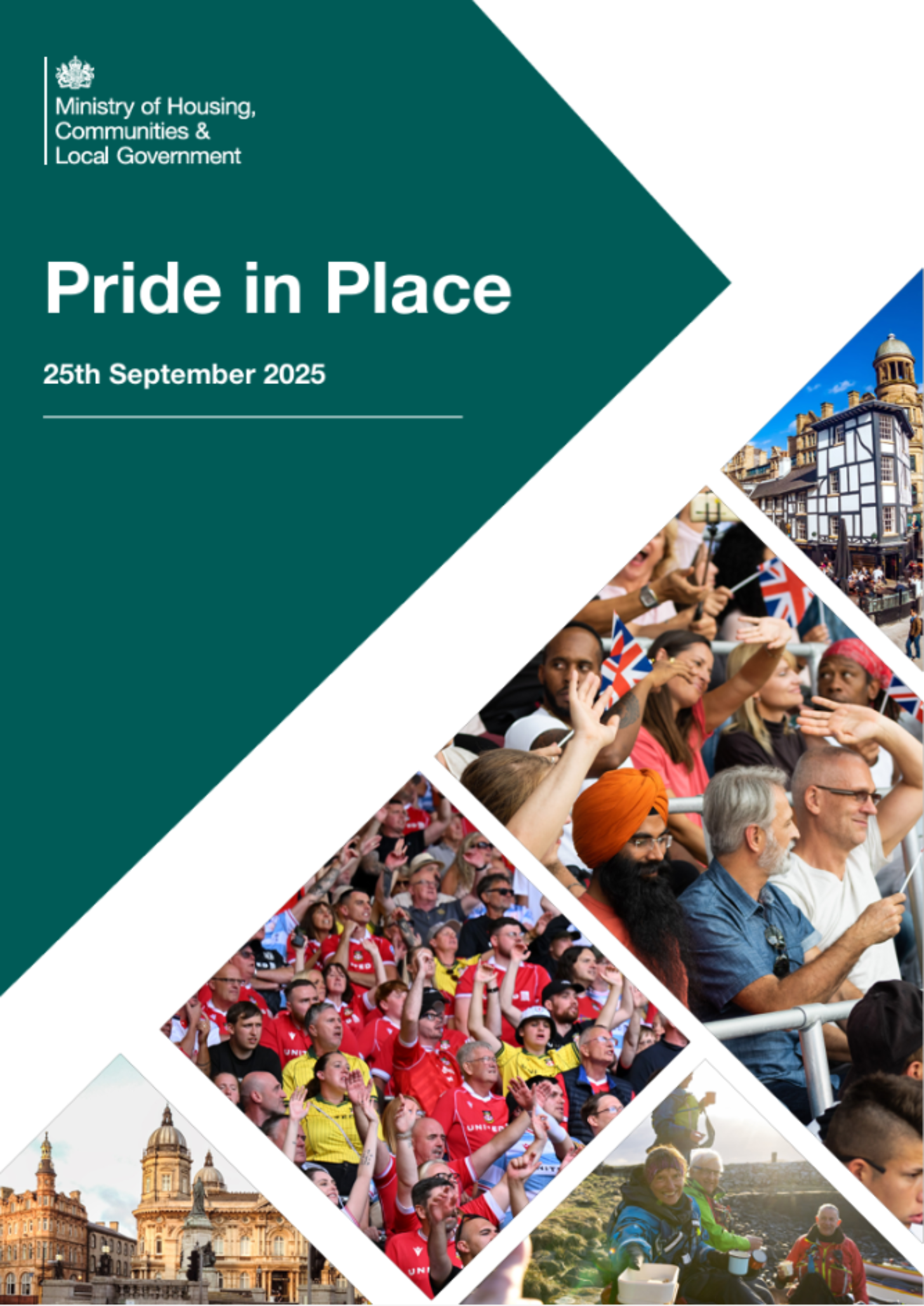
In September, the government released a “Pride in Place Strategy”. Most recently, it can be compared to the last government’s “Levelling Up” agenda. However, whereas the key funding and programmes under that approach were controlled by Whitehall via a competitive bidding approach, Pride in Place is designed to allocate funds to the areas of greatest need.
Pride in Place Programme
The core element of the strategy is the “Pride in Place Programme”. This is, in fact, the latest evolution of the last government’s “Long-Term Plan for Towns”, reformulated, expanded, and renamed as the “Plan for Neighbourhoods” by the new government in March, before adapting and expanding again to its current form.
The Programme will deliver a total of £5bn over 10 years to 244 areas experiencing the “double disadvantage” of high deprivation levels and weak social infrastructure. Seventy-five of these areas are those previously identified by the Plan for Neighbourhoods. Whereas these areas were based on a population size of 20,000 to 100,00 people, the 169 new areas will be focused on more targeted areas of around 10,000 people.
Each area will receive £20m over the next decade, to spend across the themes of “building stronger communities”, “creating thriving places”, and “helping communities to take back control of their own lives and areas”.
The plan for this money in each area will be developed by a “Neighbourhood Board”. These will be led by an independent Chair and include residents, local businesses, civil society and community organisations, and the local authority.
Neighbourhood Boards have already been established in the 75 initial areas and are due to submit their “Regeneration Plans” to the Ministry of Housing, Communities & Local Government (MHCLG) by November 28th, 2025. Boards in the latest 169 areas will now be established, with a deadline of “Winter 2026/27” to submit their plans.
Boards are able to select from a list of pre-approved interventions that will not require further government approval to fund. However, Boards are also encouraged to explore other locally determined priorities to ensure the funding meets the most pressing needs of local people.
What this means for community organisations
Current guidance for Neighbourhood Boards includes positive suggestions on the involvement of local community organisations. For example:
Encouraging them to be required members
Encouraging them to be made secretariat, rather than this defaulting to a council role
Prompting the mapping of local social infrastructure and drawing on the expertise identified
Suggesting that decision-making and budget-holding over elements of the plan could be held by community organisations
We believe community organisations must be central to the functioning of Neighbourhood Boards. They have the best understanding of the change local communities want to see and the precise scope of the “neighbourhoods” that want to see it.
But also, key to so many of the “pre-approved interventions” is the long-standing work of community organisations – from community engagement in neighbourhood renewal, to community energy projects and energy efficiency and debt advice, from business support activity for local entrepreneurs, to impactful volunteering, social action, and community cohesion initiatives. And much more besides.
If you are based in a Pride in Place Programme area and have not yet been engaged on the formulation of the local Neighbourhood Board, get in touch with your council or MP and push to be involved.
Pride in Place Impact Fund
Alongside the Pride in Place Programme sits the “Pride in Place Impact Fund” – a targeted, shorter-term pot intended to get quicker, visible wins. The fund is capital-only and aimed at tangible, place-based improvements that communities can see and use.
The Impact Fund will provide £150m to up to 95 local authority areas across England, Scotland and Wales – £1.5m per place over two years – to refurbish community spaces, improve public spaces, and revitalise high streets and town centres.
The Impact Fund will be delivered through local authorities, who will act as accountable bodies for allocations, handle grant disbursement and monitoring, and be expected to work with local stakeholders to identify projects and delivery partners.
What this means for community organisations
Following the closure of the Community Ownership Fund earlier this year, it is positive to see some remaining focus on community spaces through the Impact Fund. Community organisations are pivotal to taking such spaces into community ownership to create welcoming places for connection, support, and shared activity.
The scope of the funding is limited to capital, however, meaning it will not pay for ongoing revenue costs such as staffing and maintenance.
As the “accountable body” for the funding in each place, local authorities are asked to “engage with and seek support from a wider range of local stakeholders” to identify priorities for, and deliver, the funded activities.
While there will be no formal board for the Impact Fund in each place, we again encourage any Locality members based in the target areas to get in touch with their council or MP to make sure your voice is heard. We believe community ownership of assets should be the key focus of the Impact Fund in each place.
Our ongoing influencing
At Locality, we are in ongoing contact with MHCLG over the precise design and delivery method of both the Pride in Place Programme and Impact Fund.
We are keen to ensure that community organisations, the local people they represent, the activities they provide, and the spaces they create are placed at the heart of both initiatives, as well as the government’s wider plan for neighbourhood renewal across the country.
We’ll have more to say on this soon, so keep your eyes peeled!