

Keys to the future: central findings
How does community ownership transform communities?
Local communities are ready, willing and able to take ownership of the buildings and spaces that mean so much to them. There is an all too rare “quick win” for policymakers where a relatively small investment could rapidly unlock huge, politically salient benefits. Yet, at present, funding supply is lagging.
The case for community ownership goes far beyond protecting buildings. Community-owned assets contribute nearly £220m annually to the UK economy. Projects supported by the Community Ownership Fund leveraged an additional £2.26 in local investment for every £1 of government grant. Community spaces also reduce social isolation, improve health outcomes, strengthen social cohesion, and provide inclusive employment - particularly in areas of high deprivation.
However, these positive benefits have been hidden behind an “austerity framing” - focused on saving assets at risk rather than realising their transformative potential. Community ownership should be understood as a proactive tool for growing economies and creating strong, healthy communities, not merely a reactive response to public sector decline. This is borne out throughout this report in case studies on the real-world impact of community ownership in places across the country.
We can see how community ownership provides positive answers to the stubborn challenges that sit right at the top of the political agenda.
How can government drive meaningful economic growth in neighbourhoods that have struggled for decades?
Asset-owning community organisations lead economic development in our most disadvantaged neighbourhoods, with every £1 they generate creating approximately £2.50 for the local economy.
How can public services make a decisive shift to prevention and drive down unsustainable demand?
Access to community spaces can be critical for longer-term health outcomes, reducing loneliness, and improving access to health services, therefore lessening the pressures on social care and acute NHS providers.
How can we come back together as a country and tackle increasingly toxic division?
Community hubs widen people’s social networks, increase social cohesion by bringing together different social or generational groups, and
increase social capital and build trust.
Throughout this report, you’ll find real-world case studies from across the country showing just what this impact means in practice.
What challenges and opportunities do communities face?
- Demand is much greater than current funding. The Community Ownership Fund received around 3,800 eligible expressions of interest, worth £1.8 billion. This was more than 12 times the funding available.
- The Community Right to Buy will increase demand. The report estimates that around 190,000 potential assets could fall within scope under new definitions.
- Early-stage support is missing. Communities often need funding and advice for feasibility work, surveys, legal costs, governance and business planning before they can buy or manage an asset.
- Funding is fragmented. Communities face a complex mix of grants, loans and support programmes, often with different rules and deadlines.
- Equity must be built in from the start. Without targeted action, community ownership is more likely to benefit places with more money, time and professional networks.
- Councils have a vital role. Local authorities can help communities take on assets through community asset transfer, Asset of Community Value processes and clear community asset strategies.
Given that community ownership projects often take several years (and sometimes a decade or more) to progress from concept to operation, flexible, sustained, and hands-on support is essential. Successful community ownership was repeatedly described as a journey rather than a transaction, requiring support that extends beyond acquisition to include long-term stewardship, governance renewal, and asset management.
Our report covers success stories across the country, from Bristol to Sandwell, and provides positive examples, such as those in Calderdale, Kirklees, Bristol, and Greater Manchester, which demonstrate the potential of place-based approaches where community ownership is embedded within wider strategies. These are alongside projects sadly left stranded by the premature closure of the Community Ownership Fund and poor coordination across the sector.
Three possible futures for community ownership
The report maps three scenarios for the future of community ownership support.
- a basic scenario where we continue with our current, largely uncoordinated, individual-level response
- an intermediate scenario where funders and social investors work together in a more coordinated way to create a sector-level response
- an ambitious scenario where government plays a leading role in coordinating a system-level response, creating a National Community Ownership Strategy and a £1 billion community assets fund over five years.
We argue that the ambitious scenario is needed to match the scale of demand and unlock the full social, economic and environmental benefits of community ownership. The next phase of community ownership policy and programme design must move beyond short-term, high-risk interventions towards a more coordinated and equitable approach.
Our calls to action for government
- national government should commit £200 million at the Autumn Budget 2026 and develop a National Community Ownership Strategy.
- trusts and foundations should create dedicated funding for community ownership, starting with an initial investment of around £100 million.
- social and impact investors should coordinate blended finance, combining grants and loans in ways that reflect local need and project risk.
- community shares should be expanded as a way for local people to invest in and shape the assets they care about.
- local and strategic authorities should publish community asset strategies and make communities the first port of call when public assets are at risk of disposal.
- support infrastructure should be funded through a Community Ownership Support Engine, offering independent advice from early feasibility through to long-term stewardship.
A “new normal” of mainstreamed community ownership support within a decade
Through this coordinated, sequenced, cross-sector approach over the next five years, we can produce an environment that brings about a “new normal” of mainstreamed community ownership support within a decade and beyond.
- years 1-2 £300m from government and core charitable funders
- years 3-5 £700m plus from social investment, philanthropy, community shares, crowd funding, other programmes (e.g. Pride in Place, Community Wealth Fund)
- years 5-10 “ new normal” of mainstreamed community ownership support
A relatively modest public investment can rapidly unlock substantial, politically salient benefits
With ambitious funding and clear coordination, we can inspire a step change in community ownership. The opportunity before us is significant and time-limited. A rare policy window has opened - with the Community Right to Buy now in law, a new funding commitment, political will present across parties, and a substantial pipeline of projects ready to move. The question is whether it will be matched by the scale of funding and coordination it requires.
If done well, this is one of the rare policy areas where a relatively modest public investment can rapidly unlock substantial, politically salient benefits: visible regeneration of high streets and community spaces, economic growth rooted in local ownership, reduced pressure on public services, and communities with renewed confidence in their own power. If done poorly - or not at all - a huge opportunity will pass us by.
This report provides the evidence, the framework, and the roadmap. The will, as our research found, is there across politics, funders, and civil society. What is needed now is the ambition to act on it.
Related reports
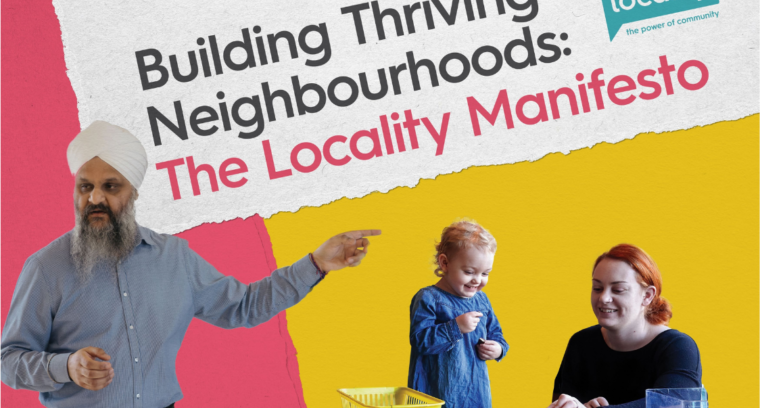
Building Thriving Neighbourhoods: The Locality Manifesto
Through the new Locality Manifesto, we’re calling for a “community power revolution”. We know that local communities are best placed to transform lives and create a fairer society.

Space to thrive
O

Community organisations and climate action
Research and practical resources to support community organisations, charities, social enterprises and community businesses to tackle climate change, including an assessment of different approaches, business models and examples to help take climate action.